November 18, 2026

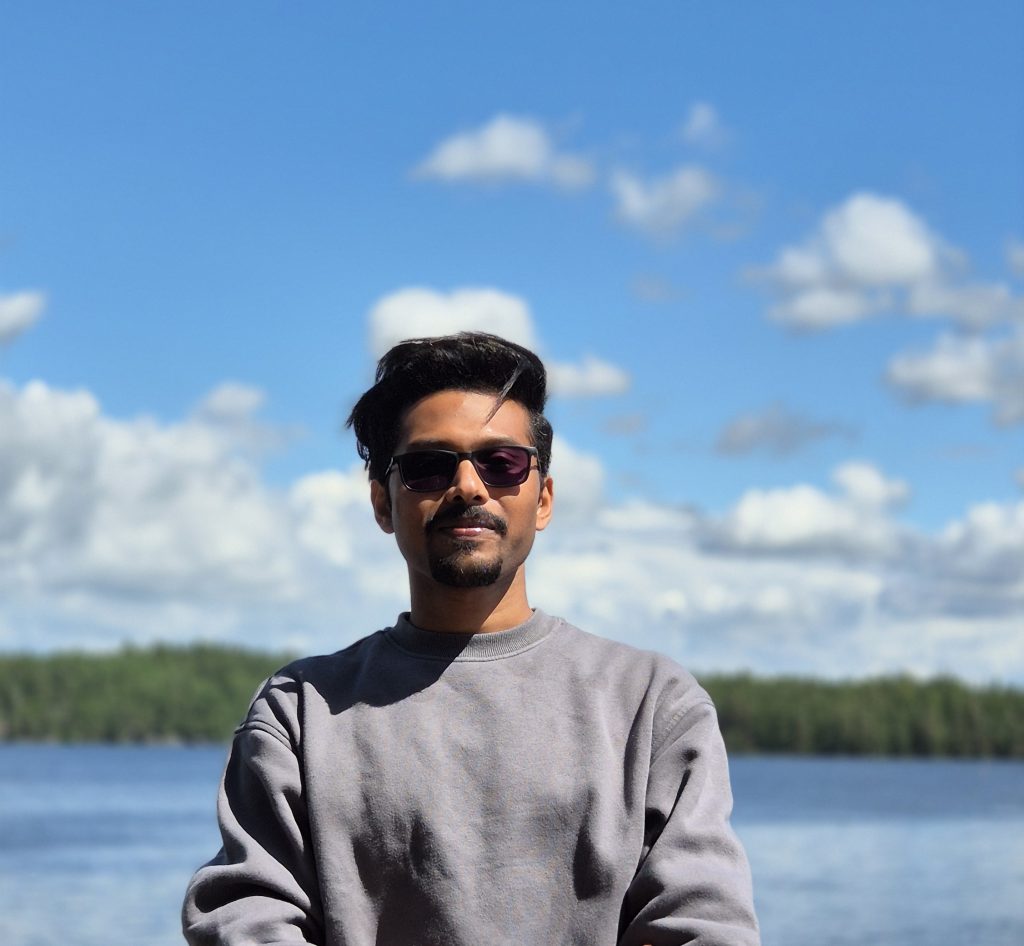
Souvik Ray, intern at InnoRenew CoE, UP IAM; Main areas of research: Wood Bonding, Finger Jointing and Engineered Wood Products (EWPs)
I grew up in Kolkata in eastern India, then moved to Dehradun for my master’s degree, and later to South India for my job as a research fellow. Now I am based in Växjö, Sweden, and doing my PhD studies in Wood Technology at Linnaeus University.
I completed my bachelor’s degree in chemistry at the University of Calcutta and later pursued a Master’s degree in Wood Science and Technology.
I saw many wooden houses in rural India, and most of them have survived for decades, if not centuries, with minimal maintenance. But in the urban areas, it is a concrete jungle. Concrete is not sustainable, yet why do we use it so much? This piqued my interest in studying the different aspects of wood bonding and the environmental impacts that might affect the wood’s service life.
LEGO. As kids, we all have built something or other with LEGO blocks. Now imagine it on a larger scale: giant blocks of LEGO stacked on top of each other in perfect orientation, and that’s what I do. But if we accidentally hit the LEGO buildings, they will collapse. The same is true with the buildings, but also with different kinds of factors. I investigate how moisture, temperature, and manufacturing conditions affect the strength and durability of wood joints, and how external conditions affect structural strength, thereby helping engineers design safer, more sustainable timber buildings.
A typical day combines laboratory experiments, data analysis, scientific reading, and writing. Depending on the objective I have in hand, I prepare wood samples, perform mechanical tests, or analyze microscopic images. I also attend a few research meetings and do a lot of writing.
For me, the most exciting part of the research is the challenges I face. The hypothesis with which I start may be false, but those false results tells me what not to do. Then there is the satisfaction of knowing that my research can contribute to a more sustainable, greener future.
The raw material itself. Wood is a naturally variable material. Even samples from the same tree can behave differently, making experiments challenging to reproduce.
It is not the work of one scientist but the cumulative research of several scientists. In my field, one major challenge of wood as a raw material is its degradation by microorganisms and fungi. In my view, modifying wood and then commercializing it (mainly through acetylation) would be one important scientific achievement.
My all-time go-to series would be The Big Bang Theory. Good humor and a great friendship bond. That is my kind of show. Moreover, I am interested in documentaries and kind of avoid the horror genre.
Recently, my friends discovered my fear of the horror genre, and they made sure I watched all the Conjuring and Anabelle series.
Of all the places I have visited in Slovenia, Izola felt like a postcard city. Calm blue waters and a clear night sky. Skočjan Caves are next on my list to visit in Slovenia.
My friends and the gossip with them, and most importantly, when the conversation starts with “you know what happened…” and the next important one is an unfamiliar bird species during a nature walk.
One realization that has shaped my life is that meaningful progress rarely comes from comfort. Moving to different cities and countries taught me that growth happens when we embrace uncertainty and remain open to learning. Curiosity, consistency, and creativity are something that I follow throughout.
Wood is good. The aromas of different woods and the aesthetic appeal of wood are what attract me. To me, wood represents the perfect balance between nature and engineering. Every piece of wood tells a story through its grain, texture, and growth rings, making each one unique. Unlike synthetic materials, wood continues to interact with its environment throughout its lifetime.