October 14, 2026

Bioluminescence, the production of visible light by living organisms, is one of nature’s most fascinating phenomena. It occurs across various forms of life, including bacteria, dinoflagellates, fungi, insects such as fireflies, and numerous marine animals.
Despite their biological differences, these organisms share the ability to produce visible light through biochemical reactions. In nature, this light serves different functions. It can be used for communication, attracting prey, camouflage, or defence against predators. Bioluminescence has also found its place in science, where it is used in biological imaging, studies of gene expression, biosensing, and environmental monitoring [1,2].
But bioluminescence raises another question: could biological light become a functional component of future technologies and materials?
Harnessing biological light
Bioluminescent systems have been used as analytical tools for decades. Light-producing bacteria, for example, can act as biological sensors for pollutants and toxic compounds. Their light emission can be measured directly and is closely linked to cellular activity, meaning that changes in luminescence can provide information about biological activity or environmental toxicity [3,4].
More recently, researchers and designers have begun exploring another possibility: using living organisms themselves as sources of light. One example comes from Rambouillet, France, where the biotechnology company Glowee developed a pilot urban installation using light-producing marine bacteria [5,6]. The microorganisms are maintained in a controlled liquid environment, with nutrients and aeration allowing them to remain active and produce their characteristic blue-green glow.
The technology does not currently provide the intensity required to replace conventional street lighting. Instead, the Rambouillet pilot demonstrates possible uses of biological light for urban signalling and other low-intensity lighting applications, while testing the practical challenges of maintaining a living lighting system outdoors. [7,8]
This case illustrates a different way of thinking about illumination: producing light through a living system rather than a conventional electrical light source.
When living light meets materials
Bioluminescence is also being explored in materials science. Researchers have immobilised enzymes involved in bacterial bioluminescence onto synthetic fibrous materials, demonstrating that components of biological light-producing systems can be incorporated into material surfaces [9]. Other studies have gone a step further by incorporating living bioluminescent bacteria into thin alginate-based sheets, demonstrating their potential as functional biological components of materials [10].
More recently, researchers at Empa, the Swiss Federal Laboratories for Materials Science and Technology, demonstrated a different approach using fungi. They combined balsa wood with the naturally bioluminescent white-rot fungus Desarmillaria tabescens, creating a hybrid living material. The resulting fungus-wood system produced visible bioluminescence. However, the light production depended strongly on biological and material conditions, particularly colonisation time and the moisture content of the wood [11].
This work demonstrates an important concept: the organism is not simply a source of a light-producing compound. The living fungus remains an active component of the material.
Exploring living light at InnoRenew CoE
At InnoRenew CoE, UP IAM, the BIOLUMICOAT – Bioluminescent microbial coating for architectural surfaces project explored the possibility of combining bioluminescence with living materials [12]. Naturally bioluminescent microorganisms were examined to explore their potential use in living coatings for architectural materials.
As part of this work, different bioluminescent microorganisms and cultivation conditions were investigated, including conditions affecting microbial growth and light emission. The project also explored interactions between bioluminescent bacteria and fungi as a possible step towards more complex living systems.
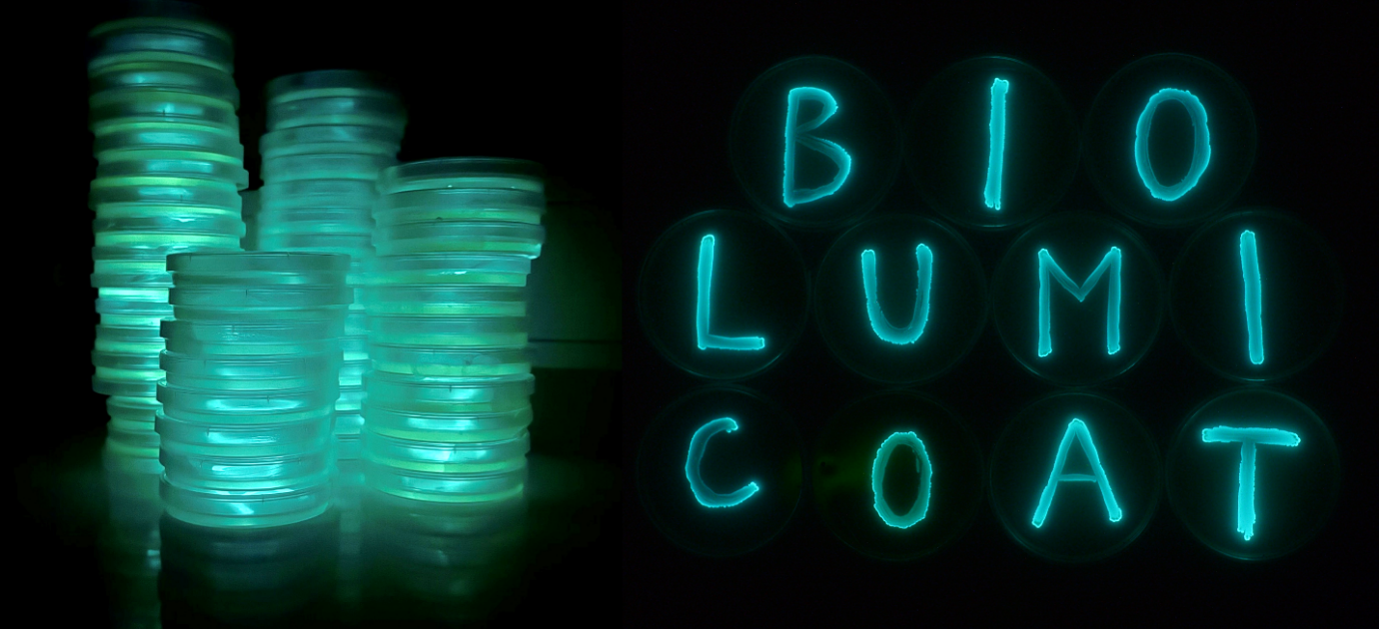
Figure 1. Visible bioluminescence from bacterial cultures investigated within the BIOLUMICOAT project. Photo author: Wojciech Pajerski / InnoRenew CoE, UP IAM.
Moving from a glowing microbial culture towards a functional living surface, however, remains a much greater challenge. The organism has to remain alive and metabolically active while continuing to produce light. At the same time, it has to interact with a non-living material. Nutrients, water, environmental conditions, surface colonisation, and the properties of this living-non-living interface therefore become part of the material design.
Bioluminescent materials are still at an early stage and are not an alternative to conventional lighting. However, studies involving bacteria, fungi and biohybrid systems show that light production can become a function of materials containing living components. In engineered living materials, the natural ability of some microorganisms to produce light could therefore become a functional property of the material itself.
References:
[1] Widder, E. A. & Falls, B. IEEE J Sel Top Quantum Electron 20, 232–241 (2014). DOI: 10.1109/JSTQE.2013.2284434
[2] Yeh, H. W. & Ai, H. W. Annu Rev Anal Chem 12, 129–150 (2019). https://doi.org/10.1146/annurev-anchem-061318-115027
[3] Girotti, S., Ferri, E. N., Fumo, M. G. & Maiolini, E. Anal Chim Acta 608, 2–29 (2008). https://doi.org/10.1016/j.aca.2007.12.008
[4] Li, Y., Zhao, Y., Du, Y., Ren, X., Ding, H. & Wang, Z. Luminescence 39, e4721 (2024). https://doi.org/10.1002/bio.4721
[5] BBC Future. The living lights that could reduce energy use (2022). https://www.bbc.com/future/article/20220407-the-living-lights-that-could-reduce-energy-use
[6] Glowee. Glowurban – Integrate bioluminescence into your city projects. https://glowee.com/glowurban/
[7] European Commission, CORDIS. Pipelight_2 – The illumination revolution, Project 101009497. https://cordis.europa.eu/project/id/101009497/reporting
[8] Université de Lyon, Pop’Sciences. En ville, innover pour éclairer mieux et moins (2023). https://popsciences.universite-lyon.fr/ressources/quand-la-lumiere-eclaire-le-vivant-un-dossier-popsciences/
[9] Iyer, S. N., Behary, N., Guan, J. & Nierstrasz, V. ACS Appl Bio Mater 3, 3401–3412 (2020). https://doi.org/10.1021/acsabm.0c00329
[10] Sasaki, S., Mochizuki, M. & Igarashi, M. Anal Sci 29, 267–269 (2013). https://doi.org/10.2116/analsci.29.267
[11] Schwarze, F. W. M. R. et al. Adv Sci 11, 2403215 (2024). https://doi.org/10.1002/advs.202403215
[12] Pajerski, W. & Sandak, A. Engineered Living Materials at InnoRenew CoE 2025. Zenodo (2025). https://doi.org/10.5281/zenodo.17106693
Acknowledgments
W.P. acknowledges the support of the Slovenian Research and Innovation Agency (project N2-0410).
Authors: Dr. Wojciech Pajerski and Dr. Anna Sandak