November 23, 2026

As part of the EU-funded AMBIENT project the cities of Dubrovnik (Croatia), Haarlem (the Netherlands), Horta (Portugal) and Katerini (Greece) have identified a number of areas where their infrastructure is potentially vulnerable to climate change effects. AMBIENT will use this work to see how (the procurement of) advanced materials can help them address these vulnerabilities. InnoRenew CoE, UP IAM, as one of the project partners, contributes to exploring the potential of advanced materials to help cities address climate-related challenges.
The total of 30 needs identified have been organised into six thematic clusters: Thermal Comfort and Energy; Resilient Building Envelopes; Coastal and Flood Resilience; Resilient Public Spaces; Structural Resilience; and Circular Materials. The clusters help make visible where there are common themes between cities and where local conditions differ. In addition, the clusters make the preparation for market dialogues more efficient and help alignment with New European Bauhaus principles.
In the Thermal Comfort and Energy cluster the cities’ needs relate to overheating and cooling, thermal performance, insulation, energy efficiency, humidity management, and other aspects affecting indoor environmental quality and comfort. For example, Horta is seeking advanced bio-based dehumidification panels to manage extreme indoor humidity, while in Haarlem the buildings are optimised for heating and struggle with too high temperatures. For Katerini the main challenge are wildfires. They threaten electricity infrastructure and the resulting smoke affects indoor air quality and public health.
The cluster relating to Resilient Building Envelopes poses challenges related to historic buildings. Dubrvonik’s historic roofs, facades, windows, doors, and pavilions have needs concerning the performance and durability of building components and materials under increasing climatic stresses such as heat, UV radiation, moisture, salt exposure or biological deterioration. Haarlem is seeking breathable, frost-resistant facade protection for historic Dutch brickwork.
Most needs in the Coastal and Water Resilience cluster (relating to e.g. coastal erosion, flooding, heavy rainfall, drainage, water infiltration and water management) are identified by Horta, a city on the Azores Islands, that is looking for a fauna-safe solution to the coastal erosion endangering homes and roads. In Katerini, saltwater intrusion corrodes concrete and steel foundations, while sea-level rise and flash floods undermine roads, pipes and treatment plants.
In the Resilient Public Spaces cluster the identified needs concerning streets, squares, parking areas and other public outdoor spaces, including paving and surface performance in relation to urban heat, permeability, drainage and changing climatic conditions. Haarlem needs to protect buildings from flooding as cloudbursts turn streets into urban waterways. Horta’s downtown streets and squares are also affected by heavy rainfall peaks and the city needs emergency drainage for public spaces.
In the Structural Resilience Cluster, the needs are connected to earthquake resilience. Dubrovnik is looking for innovative and less invasive seismic retrofitting materials and techniques that improve earthquake resilience of historic masonry buildings while preserving heritage value. Horta seeks to develop advanced strengthening materials and minimally invasive interventions for historic structures that increase seismic resistance without altering architectural heritage or requiring heavy structural modifications.
Finally, in the Circular Material Cluster Horta and Katerini have identified needs related to circular, recycled or bio-based construction materials and the valorisation of locally available material streams, residues or waste resources, such as alternative aggregates, recovered timber or other resources that could potentially be transformed into construction products.
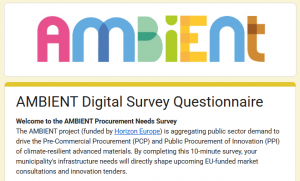
In the coming weeks, these challenges will be further refined, but AMBIENT wants to also give the opportunity to cities outside the project to address climate resilience and shape upcoming EU-funded market consultations and innovation tenders. To that end, it has developed a questionnaire that seeks to identify climate-related challenges, performance gaps in existing infrastructure and (public procurement-related) barriers to adopting innovative materials and solutions. The questionnaire can be found here and takes 10 minutes to complete.