April 2, 2026

W. Pajerski1, A. Sandak1,2
1 InnoRenew CoE, Andrej Marušič Institute, University of Primorska, Muzejski trg 2, SI-6000 Koper, Slovenia
2 Faculty of Mathematics, Natural Sciences and Information Technologies, University of Primorska, Glagoljaška 8, 6000 Koper, Slovenia
Engineered Living Materials – a new frontier
Engineered living materials (ELMs) represent one of the most dynamic frontiers of materials science. By embedding biologically derived components into material structures, researchers can create a new class of active systems with functions that go beyond conventional ones. These include self-repair, sensing, adaptive responses to the environment, pollutant monitoring, or even light emission.
In the context of sustainable architecture, ELMs are becoming a paradigm shift from traditional to unconventional bio-inspired solutions. They can be applied to surfaces (as protective or functional coatings) or integrated into bulk materials (such as hybrid composites). ELMs are enabling buildings to respond to their environment in real time – shielding against UV radiation, mineralising themselves to resist fire, or acting as distributed biosensors to detect pollutants and pathogens. These can make building more resilient, adaptive, and sustainable. Recent studies highlight their potential to function as distributed living sensors, to extend the service life of materials, and to reduce energy demand 1.
The European Innovation Council’s Pathfinder Portfolio on Engineered Living Materials recognises this potential but also underlines the challenges 2. Beyond the technical progress in modelling, design, and upscaling, the field should also place careful attention to ethical, legal, and social aspects. Transparency, community trust, and regulatory readiness are essential. Emerging technologies that incorporate living cells into material scaffolds may face hesitation from investors and the general public, making targeted communication and responsible innovation strategies indispensable.
ELMs sit at the intersection of biology, technology and society – pushing materials science toward a future in which the built environment is not only sustainable but also alive. That same trajectory is now being translated into practice in Slovenia at InnoRenew CoE, where ELM research has gained clear European visibility.
From Idea to ELM development
At the InnoRenew CoE, department of Andrej Marušič Institute of the University of Primorska, Engineered Living Materials (ELMs) is one of its central research directions. Originating from individual projects within the Materials Group, this work has developed into the ELM research line – a collaborative and informal direction linking diverse projects, researchers, and disciplines.
The story began in 2022, when the ERC project ARCHI-SKIN – Bioinspired living skin for architecture (ERC Consolidator Grant, No. 101044468) was launched under the leadership of Assoc. Prof. Anna Sandak. This breakthrough grant focuses on developing fungal biofilm coatings for architectural surfaces, delivering multifunctional properties such as UV resistance, waterproofing, self-healing, antioxidant activity, and antimicrobial protection, and it inspired further exploration of ELMs in the building sector.
In 2024, Dr. Karen Butina Ogorolec started the MSCA Postdoctoral Fellowship MICRO-INSERT – Microbially induced mineralisation of wood for improved fire resistance (MSCA-PF, No. 101105772). This project investigates the feasibility of using fungi as CaCO3 carriers to develop a novel bioinspired mineralisation process for biobased building materials, thereby improving fire safety and durability.
In 2024, Dr. Wojciech Pajerski obtained the Seal of Excellence from the European Commission for BIOLUMICOAT – Bioluminescent microbial coating for architectural surfaces (MSCA-SE/ARIS, Project No. N2-0410; started: 2025). The project, later funded by the Slovenian Research and Innovation Agency, explores microbial systems that naturally emit light, opening opportunities for energy-efficient and aesthetic building surfaces.
Around the same time, Dr. Anja Černoša secured a bilateral grant between the University of Primorska and Vilnius Gediminas Technical University for the project FUME – Fungal melanin: enemy or friend? Evaluating its role in human health and antimicrobial properties (Joint Seed Grant, Project No. UP-VGTU-2024-02). FUME investigates the biochemical properties of fungal melanin, linking its role in microbial pathogenicity with its potential for antimicrobial action and resilience in engineered living materials.
In February 2025, the research team reached another milestone: the launch of REMEDY – Archibiome tattoo for resistant, responsive, and resilient cities (EIC Pathfinder Open Project No. 101185862), coordinated by InnoRenew CoE with partners from Slovenia, Austria, the Netherlands, and Slovakia. REMEDY develops microbial inks as “archibiome tattoos” for buildings, combining decoration with resilience and environmental remediation. Importantly, REMEDY is included in the EIC Pathfinder portfolio on Engineered Living Materials and supported by the dedicated PATH2ELMs booster programme. This supportive grant enabled active contributions to key portfolio activities and the advancement of Engineered Living Materials in Europe and beyond.
Also in 2025, the LIVEMAT – Hybrid living material on bio-based composite scaffold project (WEAVE programme, NCN/ARIS, Project Nos. 2023/51/I/ST11/00713 & N2-0380) was launched. LIVEMAT advances bio-based composites by integrating living cells into structural scaffolds, merging strength with photosynthesis and carbon capture.
Together, these achievements established the ELM research at InnoRenew CoE as a recognised platform where international projects and multidisciplinary expertise converge, shaping a growing portfolio that is both scientifically ambitious and societally relevant. This progression is illustrated in Figure 1, which presents the timeline of granted ELM-related projects at InnoRenew CoE since 2022, and continues up to day. Those projects are funded through competitive European and national grants, with activities secured up to 2029.
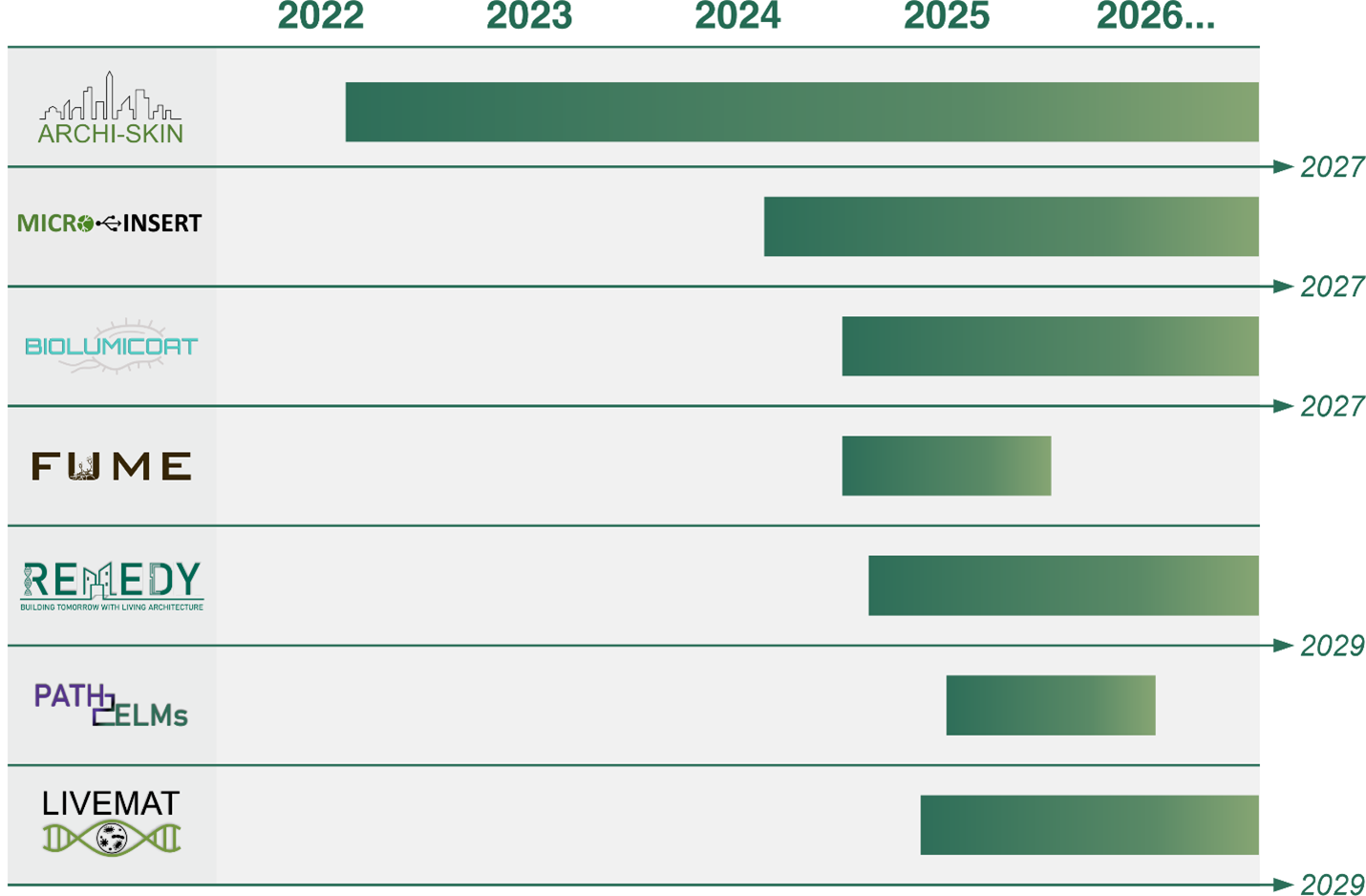
Figure 1. Timeline of Engineered Living Materials projects granted since 2022 at InnoRenew CoE/University of Primorska.
Recognition and European Context
The ELM’s research has also gained external recognition at the European level. It was featured in the European Commission’s Science4EU campaign, which highlights science with direct impact on society in Europe. One of the campaign’s parts, “Nature inspires, science builds: Fungi and the future of sustainable construction” 3, showcased the ERC project ARCHI-SKIN as a prime example of how fungi can inspire novel architectural coatings. The campaign reaches audiences across the EU through multimedia channels and partner organisations, bridging science and citizens.
In addition, InnoRenew CoE’s work on Engineered Living Materials has been included in several flagship European reports and communications. It appeared in the ERC report “Mapping ERC Frontier Research: Transformative change for a sustainable future” (2022) 4, in the ERC Annual Report on Activities and Achievements (2024) 5, and in the ERC Annual Activity Report 2024 6, which selected ARCHI-SKIN as an example of EU added value aligned with the European Green Deal. Coverage also extended to the European Commission’s Horizon Magazine article “New aerospace and building materials could repair themselves thanks to fungi and bacteria” (2024) 7.
Moreover, the ELM research is embedded in the EIC Pathfinder Portfolio on Engineered Living Materials, with the REMEDY project and its participation in the PATH2ELMs booster programme ensuring visibility and cooperation across Europe. REMEDY organized and hosted the 3rd Annual Meeting of the ELMs Portfolio, bringing together all projects within the portfolio, their collaborating researchers and industry partners, as well as external experts from across Europe.
Looking Ahead
The ELM research is positioned as a long-term framework for advancing materials research in Europe, with several projects already secured until at least 2029. In the coming years, the work will focus on translating laboratory concepts into prototypes, testing applications in real environments, and contributing to standards and policies that enable broader adoption of Engineered Living Materials.
The ELM research strategy supports the European Green Deal, the vision of resilient, low-pollution cities, and the transition to more sustainable construction. At the same time, the research team remains open to collaboration with academic, industrial, and policy partners who share the ambition of integrating biology into materials science.
References:
1. Sandak, A. Nat Rev Mater 8, 357–359 (2023).
2. European Commission: European Innovation Council and SMEs Executive Agency, EIC pathfinder portfolio – Engineered living materials – Strategic plan – Brussels, November 2023, Publications Office of the European Union, 2023, https://data.europa.eu/doi/10.2826/260175
3. Science4EU – The EU stands for science, https://research-and-innovation.ec.europa.eu/events/special-features/science4eu/countries/slovenia_en
4. European Commission: European Research Council Executive Agency, Mapping ERC frontier research – Transformative change for a sustainable future, Publications Office of the European Union, 2024, https://data.europa.eu/doi/10.2828/5997136
5. European Commission: European Research Council Executive Agency, Annual report on the ERC activities and achievements in 2024, Publications Office of the European Union, 2025, https://data.europa.eu/doi/10.2828/1252145
6. Publications Office of the European Union, Annual activity report 2024 – Publications Office of the European Union, Publications Office of the European Union, 2025, https://data.europa.eu/doi/10.2830/7270127
7.Nesvarova, M. (2024) New aerospace and building materials could repair themselves thanks to fungi and bacteria. Horizon Magazine. Retrieved from https://projects.research-and-innovation.ec.europa.eu/en/horizon-magazine/new-aerospace-and-building-materials-could-repair-themselves-thanks-fungi-and-bacteria
Acknowledgments
W.P. Acknowledgements the support of the Slovenian Research and Innovation Agency (project N2-0410).
This work was co-funded by the European Union (ERC, ARCHI-SKIN, #101044468). Views and opinions expressed are however those of the author only and do not necessarily reflect those of the European Union or the European Research Council. Neither the European Union nor the granting authority can be held responsible for them.
———————————————————————————————————
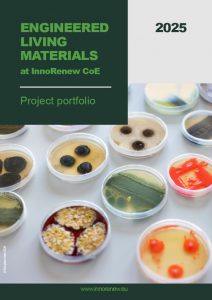
For a full overview of ELM research activities, see the Engineered Living Materials at InnoRenew CoE 2025 brochure, available on Zenodo: DOI 10.5281/zenodo.17106693
Click here to download the brochure.
Cover photo: #Science4EU campaign © European Union 2025